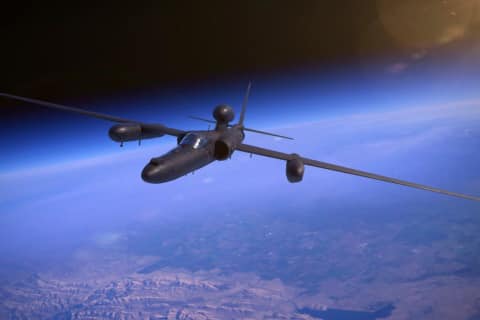
“Don’t you just get bored out of your skull up there all that time?” a young Flight Surgeon asked during my post-flight physical after a particularly grueling mission over Kablamistan. “Well,” I answered, “there are periods of monotony when station-keeping. But then I remember, I’m in a thin metal tube in a full-body pressure suit in a fragile, single-engine airplane bumping up against the edge of Space. And I think of certain and horrifying death that lies just beyond the thin plexiglass of my cockpit, in the -70 degree ultra-thin air of the Stratosphere.” I
went on: “Even If I manage to eject from my crippled airplane before the wings fold over the cockpit, I’ll drift down, in a bright orange space-suit, into hostile territory roughly the size of Texas.” His eyes were growing wider as I continued: “Then if, against the odds, I survive, I have to hope a handful of Americans fighting there will reach me before the people who will either kill me out-right or take me hostage…so, no, I don’t get bored.”
The missions were grueling and more extreme than any I had ever flown. On October 7th, as hostilities began, the President stated flatly: “We will not waver; we will not tire; we will not falter; and we will not fail.” We internalized his message and lived that simple credo—even emblazoned it on the nose of our airplanes.
The guardrails, regulations designed for pilot safety, were all but removed. We would push boundaries of human endurance to get our $1Bn dollar aircraft to where the war-fighter needed it in order to provide the exquisite capabilities only a select group of Airmen across our Air Force could.
There were severe costs to this approach. Decompression Sickness (DSC), commonly known as the Bends, and chronic back problems were frequent issues that no one complained of or admitted to until it became a crisis. Ignore the stabbing joint pain inflight, dial-up your suit pressure, and pray the bubbles don’t migrate to your brain. Lie to the Flight Surgeon who could only ground you, thereby crushing the rest of your squadron with missions you couldn’t fly. “I’m fine.” was the only correct response to, “How’re you doing?”.
We looked after one another and spoke to no one else. We checked on each other as we slept to make sure the post-mission pilot wasn’t doing the “funky-chicken” or gasping for air as their blood gasses continued to bubble nitrogen hours past the flight. Several ended up in dive chambers, one nearly lost his life, one did (not DCS related), and some would never be the same. In subsequent years, we would be asked to participate in an Air Force research project to better understand the effects of extreme exposure to high altitude and why so many had brain lesions. Most, including me, were eager to participate.
To cope with the random sleep cycle and extreme fatigue, there were government-issued pharmaceuticals. Sleeping pills to go to sleep and amphetamines distilled in sweet liquid form, aptly named “Go-Gel” to increase alertness and fight off exhaustion. When I ground-tested it, I was wide awake for 36 hours. Alternatively, there was chocolate-flavored “magic-pudding” laced with caffeine equivalent to six cups of coffee. I took it all. I would take anything to improve my chances of returning to my family.
I wouldn’t want to do it again, but I miss the best parts. Working as a team under extreme circumstances in a noble cause, trusting others with your life, sharing thoughts, hopes, and fears—it was all deeply satisfying.

 If you could read my mind...